
Messengers
series by Amanda Matthews
Messengers investigates sculptural "third entities”—natural forms that extend human ecology by transcending traditional categories, such as race, class, ethnicity, even boundaries between life and death. Fragmented and trauma-conditioned bodies become metaphorical ecotones, liminal spaces between realms, that encourage exploration of becoming rather than static states. The series employs cultural and anthropological perspectives that illuminate rupture in figurative ways, underscoring themes of fluidity and dynamism, deeply rooted in a sense of place and community, or lack thereof.
I am a ninth-generation rural Kentuckian with red crider clay in my marrow. The forest network offers me community, and from detritus, a reprisal of mythic bodies through expanded kin. New growth unfolds as threads and roots of unexpected connection.
Artist Acknowledgement:
The land and waters I tend, located on Russell Cave Road in Lexington, KY, are the ancestral homelands of the ᏣᎳᎫᏪᏘᏱ Tsalaguwetiyi (Cherokee, East), 𐓏𐒰𐓓𐒰𐓓𐒷 𐒼𐓂𐓊𐒻 𐓆𐒻𐒿𐒷 𐓀𐒰^𐓓𐒰^ (Osage), S’atsoyaha (Yuchi), and Shawandasse Tula (Shawanwaki/Shawnee) peoples. My relationship to this place is deeply rooted in love, acts of reforestation, restoring waterways, and creating art from the forest's gifts. My commitment grows through actions of care and reciprocity, by listening to this land, honoring its stories, and stewarding it in ways that respect enduring connections of its Indigenous peoples and health of future generations.
Artist Statement:
Ancestor and descendant, amoeba and mammoth, hawk and mouse, forest and wind, chaos and pattern, particle and wave. We are born from the same stars, sculpted from the same source, and contain the same life force.
Please follow Amanda's work in real-time here:


Thuja:
Tree of Life,
Dryad
Thuja, inspired by a section of cedar resembling a human leg and torso, is an intersex figure challenging a gender binary. Named after the Latin for "tree of life," Thuja symbolizes the union and balance of Yin and Yang—forces in Eastern philosophy that represent complementary aspects of existence. This form highlights the interconnectedness and spectrum of these energies, embodying their harmony and fluid interplay.
Rupture
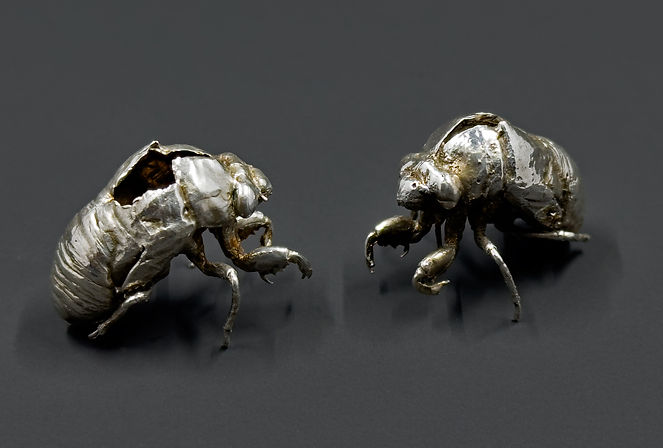

Cast from discarded cicada exuvia, these tiny silver sculptures capture the moment of rupture as a visual and metaphorical ecotone—a fertile space of becoming.
Rupture represents creative destruction.
It signals an irreversible beginning of a new phase defined by vulnerability, renewal, and growth.


Jawbone Necklace
Often described as “wearable architecture,” this bronze, silver, garnet, and leather jawbone necklace symbolizes power, resilience, beauty, and adaptability. Inspired by historic women’s sartorial and subversive adornments that doubled as tools and weapons, the remains of this fragmented body are reborn as ornament, excavator, and bludgeon.

Rhiza:
Honeysuckle Root Dryad
Inspired by a large honeysuckle root, Rhiza’s name, derived from “rhizome” or “root,” reflects her connection to Nubian heritage as the foundational agrarian society. Rhiza channels mystical energy into creative acts, finds purpose in working the land, and leads in harmony with earth’s cycles—viewing death as renewal and every ending as a new beginning.
Scabbard
Drawing inspiration from a burl shaped similarly to a vulva, Scabbard embodies protection, creation, and healing. Historically, the term "scabbard" referred to the sheath of a warrior's blade, commonly associated with male ownership, while its Latin root, vāgīna, later came to denote anatomical structures.
The complex grain of the burl mirrors the folds of the vulva, arising as the tree heals from stress or injury and forms a scab or scar. In parallel, the vulva and womb serve as sites development, adaptation, and evolution.
Scabbard thus stands as a symbol rich in metaphor, representing resilience emerging from adversity and the dynamics of power. The name evokes the memory of weaponry, alluding to historical contexts where feminine identity has been framed by what it holds for the masculine.

Lilith
Lilith embodies the clash of reason and religious oppression. A champion of equality, she rails against any doctrine that mandates submission.
An enduring figure of folklore, Lilith is cast as both goddess and demon, and is celebrated by many as history's first feminist.
She chose freedom and independence over a dominating companion and theology. Living among nature, she is revered as integral. For Lilith, Hell is unchecked power in the hands of the misguided.


Katsina:
The Sacred Dancer
Katsina is inspired by Native American Hopi dolls that represent the Katsinam, spirit messengers of the universe. Katsina looks to the sky for inspiration, needing no intermediary to express her wisdom, intellect, grace, and gifts.
She hears and understands the music of the Universe, and dances in rhythm with the elements as she moves through time and existence. She exercises reason and enlightenment, knowing the stars and trees are all sculpted from the same source and contain the same life.
Katsina was born from a small stick that appeared to be dancing, found while walking along a riverbed in Kentucky.
Maquette 12" (Left) Enlarged bronze 6' (right)


Pan
Inspired by a section of horned, burl oak, Pan represents a faun. He is a Greek god depicted with hindquarters, legs, and horns of a goat, and the upper body and hands of a man.
Pan personifies the entire cosmos, embodying both the lower animal nature as well as the higher spiritual nature of humanity. This dual nature as both divine and animal plays upon the tenuous balance between chaos and harmony, the primal and the cultured.
Pan caused individual, possession-like disruptions of the psyche, or panolepsy, a euphoric alteration of consciousness sometimes referred to as divine mania. The word panic itself is attributed to Pan for many reasons. In addition, Pan was later known for his music, which was capable of arousing inspiration, sexuality, or even panic itself, depending upon the god's intentions.
Eos
Inspired by a spiraling section of wood, Eos' form hints of regenerative DNA, representing the fundamental essence or blueprint of all existence as one of constant renewal. She heralds a message of new beginnings, hope, and the promise of light after darkness as the goddess of the dawn.
She represents the triumph of consciousness over the void and embodies the fleeting, beautiful moments of transition, when possibilities awaken.
Her daily ascent across the sky signifies the unfurling of potential in every new opportunity. Her tears, which become the morning dew, express grief that contributes to restoration.


Eos Maquette right
Eos Detail left


Amalthea
Amalthea, whose name means "tender goddess," is revered as the foster mother of the infant Zeus. Often depicted as a goat or a hybrid goat-woman, she nourished the future king of the gods.
When Zeus was a baby, a rambunctious moment led him to accidentally break off one of Amalthea's horns, which was transformed into the fabled Cornucopia, or "Horn of Plenty." It was imbued with the magical power to provide its owner with anything they desired.
After Amalthea's death, Zeus honored her memory by fashioning the legendary Aegis, his formidable shield, from her hide. As a final tribute, he placed her likeness among the stars, creating the constellation Capra, meaning "she-goat," to immortalize her nurturing spirit.

Relic
Relic is a horse-spirit dryad, remnants of mother and child, formed of jawbones and ancient wood, cast in bronze. Like a paleontological figure unearthed from a fossil bed, it carries the impression of a creature gone long ago. Relic is a testament to maternal love and sacrifice. The anguish of loss etched onto the soul, persisting long after the physical form has faded and becomes an ancestor.

Ptelea:
Elm Tree Hamadryad
Hamadryads are born inextricably bound to a single tree. Some hold that they are its living soul, unlike the dryad, who merely dwells within. When the tree falls, so too does its hamadryad; thus, the wrath of dryads and gods pursue those who injure these sacred forms.
THE HAMADRYADES were eight Dryad daughters of the forest-spirit Oxylos ("Of the Forest") and the nymph Hamadryas ("One With Tree") of Mount Oita (Oeta) in northern Greece.
Selected Two-Dimensional and Bas-Relief Work in earlier Messenger Series


The vast forest behind my childhood home offered communion, sharing deep connections through cycles of growth and decay. Harmony revealed wisdom among these ancient beings. Our sacred ancestors, trees appear to have lived on earth for approximately 360 million years, while data suggests humans have existed here roughly 300,000-400,000 years. Therefore, humans represent less than a minute in the 24-hour day that is the life of trees.